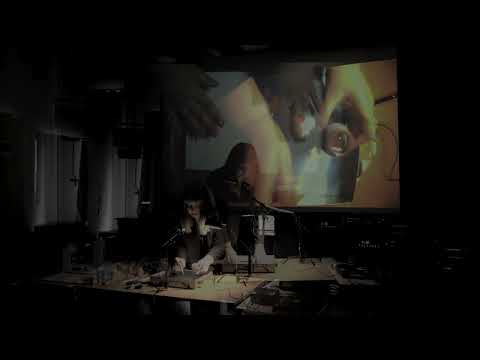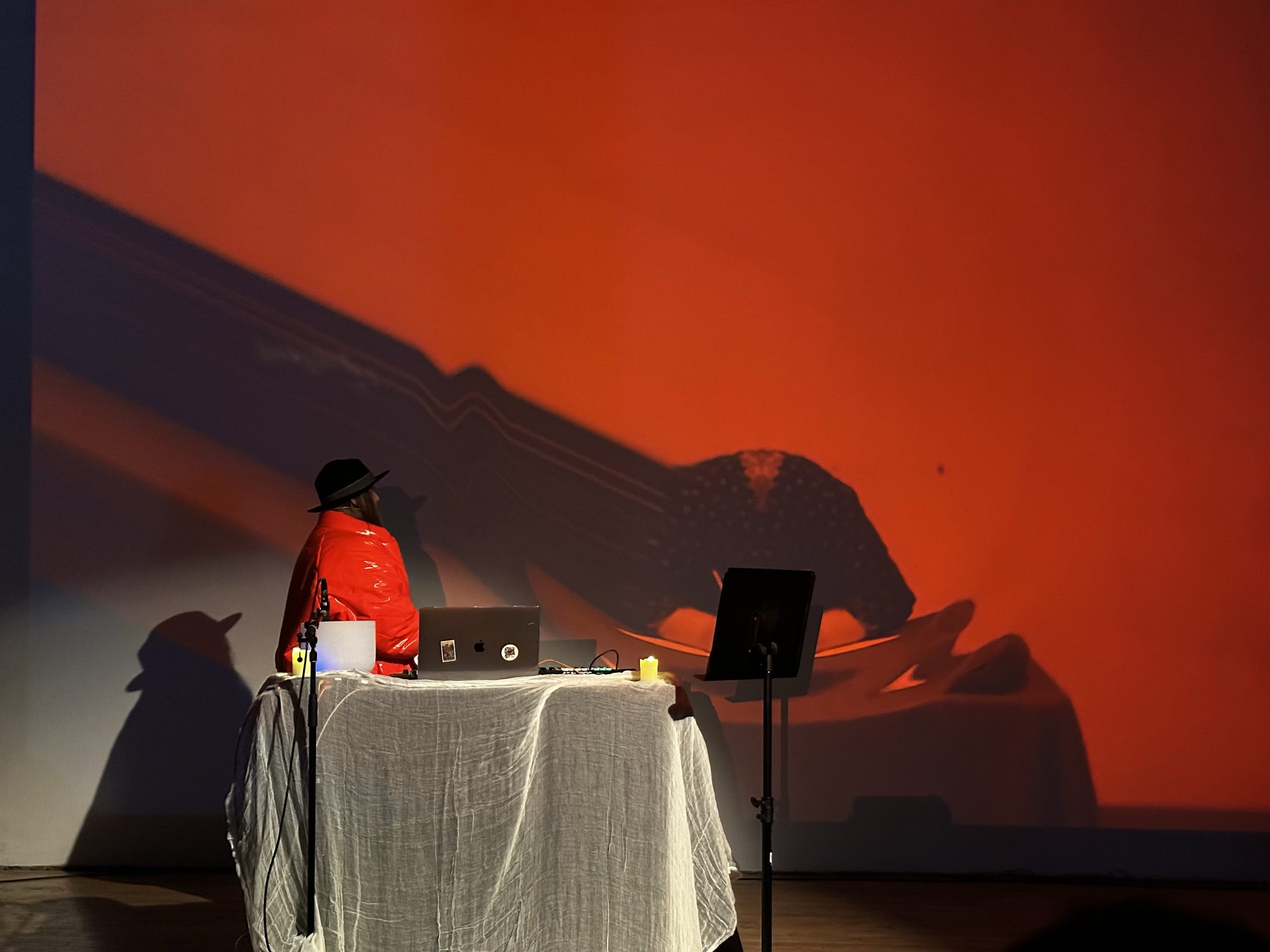
Eda Er is a composer, multimedia artist, and vocalist. She writes for voice, instruments, and live electronics, and builds performance systems in which physical gesture becomes sound and image in real time.
Composer·Multimedia Artist·Vocalist
Working at the intersection of voice, technology, and audiovisual performance
Her work positions storytelling as a compositional system across sound, image, and performance.
Explore Project →“A scenography and the darkness of the space… a kind of sanctuary prefiguring some morbid sacrifice… catching the eye as much as the ear.”
— Michèle Tosi, ResMusica · Festival de Royaumont, 2023
Eda Er is a composer, multimedia artist, and vocalist. She writes for voice, instruments, and live electronics, and builds performance systems in which physical gesture becomes sound and image in real time.
Eda Er composes works in which sound carries narrative weight — not as accompaniment to a story, but as the structure through which time, memory, and presence are shaped. Her pieces integrate extended vocal technique, electronics, and visual media, often placing the performer inside a system that listens and responds: the boundary between instrument, body, and environment is treated as porous rather than fixed.
Her practice is grounded in feminist new media studies and postcolonial theory. Augmented instruments become sites where suppressed traditions — those historically excluded from concert music — can re-enter contemporary musical thought; questions of who has been permitted to compose, to notate, and to be heard shape the forms this work takes. Grief, diaspora, and generational silence operate not as subjects of the music but as compositional forces within it, and technology, in her practice, serves as an instrument of reclamation rather than erasure.
Instructions for Not Disappearing (2025–26), a piece for solo soprano, Ebru instrument, live electronics, and video, is structured as a five-section alchemical arc from Prima Materia to Gold — using transformation as a way to think about grief, reclamation, and the politics of voice.
Across her work, storytelling is not representation but architecture — an active force that gives sound its shape.
Her current research centers on Fluid Narratives, a performance system that transforms the traditional Turkish art of Ebru (marbling) into a sonic and visual instrument. Combining live video, multichannel sound, and computer vision, the system translates physical gesture into sound and image in real time.
The project treats material processes — water, pigment, breath — as compositional frameworks in their own right, expanding what notation can carry and what an instrument can be.
Fluid Narratives →Her work has been performed internationally by ensembles and institutions including the Antwerp Symphony Orchestra, Ensemble Multilatérale, San Francisco Contemporary Music Players, Ensemble Crash, Ensemble Musikfabrik, and the Nordic Trombone Quartet.
Eda Er is currently completing her PhD in Music Composition with a Designated Emphasis in New Media at the University of California, Berkeley (CNMAT / BCNM). She is the recipient of the Prix de Paris and is active as both a composer and performer in Europe and the United States.
Based between the San Francisco Bay Area, US, and Strasbourg, France.
Chercheuse doctorale invitée, Université de Strasbourg.
Eda Er's research sits at the intersection of artistic practice and critical inquiry, working across composition, performance, feminist theory, and new media technology. Her central questions concern how embodied knowledge — the knowledge held in gesture, breath, material, and cultural memory — can be translated into and through technological systems without being flattened or neutralized by them. Grief, diaspora, and generational silence shape the forms this work takes; new media technologies, in her practice, serve as instruments of reclamation rather than erasure.
Her work draws on feminist new media studies, postcolonial theory, and the philosophy of technology to interrogate what it means to compose with systems that remember, listen, and respond. She is particularly interested in the design of augmented instruments as sites of feminist practice — tools that do not simply amplify but that reconfigure the relationship between performer, material, and audience. Central to this is a concern with who has historically been permitted to compose, to notate, and to be heard, and what new forms of authorship become possible when the instrument itself is built from suppressed traditions.
Methodologically, she develops compositional systems grounded in material process — water, pigment, breath, surface — and translates these into notational frameworks, live electronics, and spatial audio structures. Extended vocal techniques, multichannel diffusion, and real-time computer vision form the technical substrate of her practice, always in service of a deeper inquiry into embodiment, rupture, and cultural transmission.
Fluid Narratives is Eda Er's doctoral artistic research project, transforming the traditional Turkish art of Ebru — Ottoman water marbling, historically practiced by women — into an augmented instrument for live composition and feminist storytelling. The project develops a custom performance system integrating contact microphones, computer vision, transducers, and multichannel diffusion, in which the physical act of marbling becomes a real-time compositional gesture: pigment dropped into water, combed into form, translated into sound and image simultaneously.
The primary finished work under this research is Instructions for Not Disappearing — a piece for solo soprano, Ebru instrument, live electronics, live video, and movement. The work is structured around a five-section alchemical arc moving from Prima Materia to Gold, using the transformative logic of alchemy as a metaphor for the processes of grief, reclamation, and survival that animate the project's feminist and postcolonial concerns.
Central to the research is the development of an Ebru Notation System — a gestural score language that maps the physical vocabulary of marbling (drop, comb, pull, swirl, veil) onto musical parameters, enabling Ebru to function not only as visual art but as a compositional tool with its own internal grammar. This system bridges the intuitive, improvisatory quality of traditional Ebru with the structural demands of contemporary composition and live performance.
To perform is to transmute. To compose is to reclaim. To create is to survive.
Recent releases. All available on Bandcamp →
▶
▶
▶
▶
▶
▶
▶
▶
▶
▶
▶
▶
▶
▶
▶
▶
▶
▶
▶
▶
▶
▶
▶
▶
▶
▶
▶
▶
▶
▶
▶
▶
▶
▶Album
Entre Deux Rivages (2021, Nyxphere) is a collaborative album created with jazz musician Simon Sieger, released under the duo name äbädä. The record moves between contemporary classical composition, electronic sound design, and improvisation — tracing landscapes of memory and transition across its eight tracks.
Earlier performances and events from 2016–2022 are available on request — info@edaer.me
Materials for presenters, curators, journalists, and programmers. Download one-page press kit →
Eda Er is a contemporary classical composer, multimedia artist, and vocalist. Her work spans live electronics, audiovisual performance, and extended vocal techniques, exploring embodiment, feminist storytelling, and the relationship between sound, image, and physical gesture. She is a PhD candidate at the University of California, Berkeley (CNMAT/BCNM) and recipient of the Prix de Paris. Her music has been performed internationally by the Antwerp Symphony Orchestra, San Francisco Contemporary Music Players, Ensemble Musikfabrik, Ensemble Multilatérale, Ensemble Crash, and the Nordic Trombone Quartet.
Eda Er is a contemporary classical composer, multimedia artist, and vocalist working at the intersection of live electronics, audiovisual performance, and feminist storytelling. Her practice develops works in which sound functions as a narrative agent — shaping the experience of time, space, and identity through immersive and interdisciplinary forms. Her compositions integrate extended vocal techniques, electronic sound, and visual media, often placing the performer within systems that blur the boundaries between instrument, body, and environment.
A central focus of her current work is Fluid Narratives, an interdisciplinary research project that transforms the traditional Turkish art of Ebru (marbling) into a performative instrument for live composition. Combining live video, multichannel sound, and algorithmic processes, the system translates physical gesture into sonic and visual structures in real time — proposing alternative models in which material processes and embodied actions function as compositional frameworks.
Her work draws on feminist new media studies, postcolonial theory, and the philosophy of technology to interrogate what it means to compose with systems that remember, listen, and respond. She is particularly interested in the design of augmented instruments as sites of feminist practice — tools that reconfigure the relationship between performer, material, and audience.
Eda Er is currently completing her PhD in Music Composition with a Designated Emphasis in New Media at the University of California, Berkeley (CNMAT / BCNM). She is the recipient of the Prix de Paris and Chercheuse doctorale invitée at the Université de Strasbourg. Her work has been performed internationally by ensembles and institutions including the Antwerp Symphony Orchestra, Ensemble Multilatérale, San Francisco Contemporary Music Players, Ensemble Crash, Ensemble Musikfabrik, and the Nordic Trombone Quartet.
Performance and press images. For high-resolution originals, please get in touch.
Selected recordings and video documentation.
▶
▶
▶
▶
▶
▶Full curriculum vitae available upon request. Please get in touch.